| |
 Granular Activated Carbon for Gas Desulfurization
 |

 Introduction: |
|
| This
series is of medium or large pore size, suitable
for gas desulfurization. It has high activity,
large absorption capacity, low air flow resistance,
and is easy to reactivate. It has good technical
strength, endurable under high temperature, high
pressure and water impregnation.
It
is used for desulfuration of industrial gas, flue
gas or fuel gas, eg coal gas, coke oven gas, natural
gas. Particularly it is effective for gases in
which the amount of O2
is more than two times of that of H2S.
It can be reactivated while high purity element
sulfur is obtained as byproduct. |
Technical
Specification: |
|
In
conformity with GB7701.1.97 and GB7702.1-22.97
Type |
RS-1 |
RS-2 |
RS-3 |
TA-1 |
TA-2 |
RS-4 |
RS-5 |
Diameter |
φ3.0-4.5
L6-18 |
φ3.0-4.5
L5-15 |
φ3.0-4.5
L5-12 |
φ3.0-4.0
L5-15 |
φ3.0-4.5
L5-12 |
φ3.0-6 (spherical) |
φ3.0-4.0 |
Sulfur absorption mg/g |
550 |
800 |
900 |
700 |
800 |
800 |
1000 |
Strength % |
≥95 |
≥90 |
≥90 |
≥90 |
≥90 |
≥85 |
≥90 |
Water absorption % |
≥40 |
≥55 |
≥70 |
≥50 |
≥65 |
≥45 |
≥65 |
Water % |
<5 |
<5 |
<5 |
<5 |
<5 |
<5 |
<5 |
Pore volume cm3/g |
>0.4 |
0.5-0.6 |
0.6-0.7 |
0.45-0.6 |
0.55-0.7 |
>0.4 |
0.55-0.65 |
Bulk density kg/L |
0.60-0.65 |
0.50-0.55 |
0.45-0.53 |
0.6-0.70 |
0.55-0.60 |
0.55-0.65 |
0.5-0.55 |
|
Working
Mechanism: |
|
- Removing H2S
H2S is catalyzed
by the active sites on the surface of activated
carbon to react with O2:

The H2O formed goes
away with the gas flow, and the element sulfur
is captured by the activated carbon.
-
Removing
organic sulfide
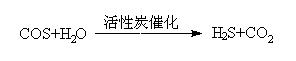
COS
accounts for over 95% of the organic sulfides.
COS can be catalyzed at normal temperature
by the activated carbon to react with H2S
(see below), and the H2S formed
is further oxidized to element sulfur.
|
Application
Guide: |
|
- Air flow: 300-600h-1, civil gas:
≤100h-1
- Temperature: normal temperature to 80°C,
preferably 30-50°C.
- Oxygen/sulfide ratio: ≥2:1
- Pressure: normal pressure to 8.0MPa
- Line speed: 0.06m/s-0.1m/s, civil gas: 0.01-0.05m/s
- Humidity: 70-100%(Liquid water is not
to be expected)
- Caution:
- Supplement oxygen until the oxygen/sulfide
ratio is 2:1 or more, if the gas to be treated
is of oxygen deficiency.
- Avoid liquid water. Liquid water may occupy
the pores of activated carbon, reduce the
surface area and hence weaken desulfurating
ability.
- If the gas to be treated does not contain
NH3+,
use alkaline activated carbon.
- Kept in cool dry places. Avoid moisture.
- Avoid tar like substances contamination!
It may enclose the surface and pores of activated
carbon and cause irreversible impairment.
|
|
|
|
|
|